Paso Robles homes and businesses face wide temperature swings, and poor insulation leads directly to higher energy bills and inconsistent indoor comfort. CAL FOAM Inc. installs spray foam insulation throughout Paso Robles and the surrounding area, addressing air leaks and temperature control problems at the source rather than masking them.
Many properties in our service area rely on outdated insulation materials that settle, absorb moisture, or leave gaps where air escapes. Spray foam fills cavities completely and creates an air seal that traditional batt or blown-in insulation cannot match.

Spray foam performs differently depending on where it’s installed, and the application method, foam type, and thickness all change based on the structure. We assess each area of your property separately to determine the right approach, whether you’re insulating a single attic or an entire commercial facility.
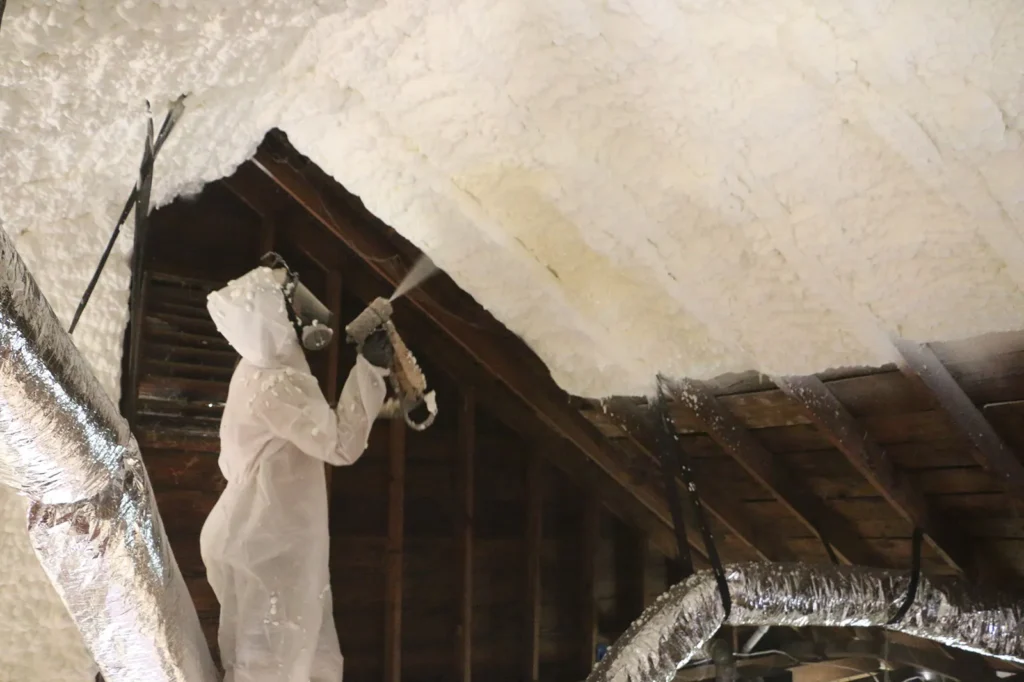
The attic is often where we see the most significant energy loss in a home. We apply spray foam directly to the underside of the roof deck, creating a conditioned attic space rather than relying on traditional ventilation methods.
This approach stops heat transfer before it reaches your living space. It also seals off gaps around vents, chimneys, and wiring penetrations that typically let air escape.
For commercial roof assemblies, we use closed-cell spray foam to add structural rigidity and moisture resistance. This matters in buildings with flat or low-slope roofs, where standing water and thermal cycling create ongoing stress.
We insulate exterior wall cavities during new construction, renovations, and room additions.
Our residential insulation services help homeowners improve indoor comfort and maintain more consistent temperatures throughout their homes.
Spray foam fills irregular spaces around studs, outlets, and framing that fiberglass batts often miss.
Key advantages for wall applications:
For additions, we match the insulation performance of new walls to the existing structure. This prevents the new space from feeling noticeably different in temperature from the rest of the building, which is a common complaint with mismatched insulation types.
Crawl spaces and rim joists are frequent sources of drafts and moisture problems. We apply closed-cell foam to rim joists because it resists water absorption and blocks air infiltration at the point where the foundation meets the wood framing.
In crawl spaces, spray foam on the walls or subfloor reduces humidity transfer into the home above. This is particularly relevant in our region, where temperature swings between day and night can drive condensation in unsealed crawl spaces.
Sealing this area also limits pest entry points, since gaps around pipes and framing get filled during application.
Commercial buildings have different insulation demands than residential properties, largely due to their size and usage. Offices and retail spaces benefit from spray foam’s ability to reduce HVAC strain across open floor plans and near large glass storefronts.
Warehouses present a different challenge, with high ceilings and metal building construction. Our commercial insulation services include applying spray foam to interior metal panels to help control condensation that could otherwise drip onto inventory or equipment.
| Building Type | Primary Benefit |
|---|---|
| Offices | Consistent temperature across zones |
| Retail | Reduced HVAC cycling near storefronts |
| Warehouses | Condensation control on metal surfaces |
We size each commercial project based on square footage, ceiling height, and current insulation gaps identified during inspection.

Air leakage and insufficient insulation are two of the most common reasons homes and commercial buildings in the Paso Robles area struggle with uneven temperatures and high utility bills. We look at how spray foam addresses these issues, along with the risks that come from leaving gaps unsealed.
Air infiltration occurs when outside air enters a building through small gaps, cracks, and seams in the structure. These openings often appear around windows, doors, electrical outlets, and where different building materials meet.
Spray foam expands on application, filling irregular spaces that rigid insulation cannot reach. Once cured, it forms a continuous barrier that limits air movement between conditioned and unconditioned spaces.
This results in fewer cold spots near exterior walls and more uniform temperatures from room to room. We find that properties with spray foam tend to maintain steadier indoor conditions throughout the year, regardless of outdoor weather shifts.
When a building has fewer air leaks, heating and cooling systems don’t have to work as hard to maintain a set temperature. This can translate into reduced run times for furnaces and air conditioners.
Industry data indicates that air infiltration accounts for up to 40% of energy loss in a typical building. Sealing these gaps with spray foam can directly address a significant portion of that loss.
Lower HVAC demand may also reduce wear on mechanical equipment over time. While exact savings vary by building size, climate exposure, and existing insulation conditions, the underlying principle remains consistent: less air leakage means less energy required to offset it.
Buildings with poor or outdated insulation often show clear warning signs. Common issues include:
These symptoms point to gaps where conditioned air escapes and outside air enters. Over time, this forces heating and cooling equipment to compensate, which increases energy consumption and monthly costs.
We often see this in older homes and commercial buildings where insulation has settled, degraded, or was never installed to current standards.
Insulation gaps don’t just affect temperature and cost — they can also create conditions for moisture buildup. Warm, humid air entering through unsealed areas may condense when it meets cooler surfaces inside walls or attics.
This condensation can lead to mold growth, wood rot, or damage to insulation materials over time. Closed-cell spray foam, when installed correctly, acts as a moisture barrier in addition to an air seal.
However, proper installation is critical. Incorrect application thickness or coverage can leave areas vulnerable rather than protected, which is why we follow manufacturer specifications and local building code requirements on every project.
We bring local knowledge, careful project planning, and material expertise to every job we take on. These three factors determine whether your insulation system performs the way it should for years to come.
We know the building styles common to this area, from older ranch-style homes to newer commercial construction. That familiarity helps us identify problem areas quickly, whether it’s an underinsulated attic or gaps around a commercial loading dock.
We discuss your goals directly with you, whether that’s lowering energy bills, improving comfort in a specific room, or meeting a commercial energy code requirement.
We walk you through various options and explain the trade-offs in R-value, cost, and moisture control, so you can make an informed decision for your property.
Every project follows the same sequence: we evaluate your property, select the right foam type, prepare the space, apply the insulation, and confirm the results before you move back in.
We start by inspecting the areas you want insulated, whether that’s an attic, crawl space, or an entire commercial structure. During this visit, we look at existing insulation, moisture levels, air leaks, and any structural issues that could affect installation.
We also ask about your goals. Are you trying to lower energy bills, fix a specific cold spot, or meet a building code requirement for new construction? Your answers shape our recommendations.
Before we leave, we provide a written estimate that outlines the scope of work, the type of foam we recommend, and the total cost. We don’t guess at square footage or skip the walkthrough; accurate assessment is what keeps the installation on budget and on schedule.
We choose between open-cell and closed-cell foam based on the specific needs of your space.
| Factor | Open-Cell Foam | Closed-Cell Foam |
|---|---|---|
| Density | Lower, softer texture | Higher, rigid structure |
| R-value per inch | Around R-3.5 | Around R-6 to R-7 |
| Moisture resistance | Absorbs some moisture | Acts as a vapor barrier |
| Best use | Interior walls, attics | Roof decks, crawl spaces, exterior walls |
| Cost | Lower | Higher |
Interior walls and attics in a moderate climate often call for open-cell spray foam, since it’s cost-effective and allows some breathability. Crawl spaces, basements, and areas exposed to moisture usually require closed-cell foam because of its vapor barrier properties.
We walk you through this decision rather than defaulting to one product for every job. Learn more about our spray foam insulation services to explore the options available for your property.
Before spraying begins, we mask off surfaces that aren’t being insulated, including flooring, fixtures, and furniture. We also check that the workspace has adequate ventilation, since the application process releases fumes during curing.
Our crew applies the foam in controlled layers, monitoring thickness and temperature as we go. Spray foam expands quickly, so precise technique prevents overfilling cavities or leaving gaps.
Ventilation doesn’t stop once the spraying is done. We run fans and keep the area ventilated throughout the curing period, which typically takes 24 hours depending on the product and conditions. This step protects both the quality of the installation and the air you’ll eventually breathe in that space.
Once the foam has cured, we conduct a final walkthrough with you. We check coverage, look for any missed spots, and confirm the foam has set correctly.
We also explain reentry timing. Most homeowners and business owners can safely return to treated areas within 24 hours, though we adjust this guidance based on the specific foam product used and the size of the job.
Before we leave, we answer any questions about maintenance or what to expect in the weeks ahead as the space settles into its new insulation performance.
Paso Robles, California, a city with a rich history dating back to its founding in 1889, offers a vibrant and welcoming community for residents. Known for its quaint downtown area, beautiful wineries, and hot springs, Paso Robles is a great place to call home.
The city’s history is filled with tales of early settlers, agriculture, and growth, making it a fascinating place to learn about the past. Today, Paso Robles attracts visitors and residents alike with its small-town charm, friendly community, and beautiful scenery.
Residents of Paso Robles enjoy a variety of amenities, including local shops, restaurants, and a bustling farmers’ market. The city is also home to several parks, museums, and annual events, providing entertainment for all ages. We also serve nearby communities with services such as San Luis Obispo spray foam insulation and spray foam insulation in Atascadero, helping property owners improve indoor comfort and energy efficiency.
We are grateful to the residents of Paso Robles for their continued support and business throughout the years. As a spray foam insulation contractor, we look forward to continuing to serve homeowners and businesses in this wonderful city and surrounding communities. Thank you, Paso Robles, for allowing us to be a part of your community.
EXCELLENT Based on 26 reviews
 Posted on Google

 Jake KnottsWe needed a 20’ container spray foamed on very short notice. Derek and his team from Cal Foam did an excellent job, worked efficiently, and were very professional all the way around. Highly recommend.Posted on Google
 Tyler HaugenGreat experience with CalFoam on our cabin project! They used closed cell spray foam to provide a permanent air seal and moisture barrier in a tight space. The added sound proofing is a huge plus, and the cabin stays at a constant temperature. If you want the top current insulation for any build, give these guys a call!Posted on Google
 EvaThis company lives up to its 5 Star review. I had a terrible rodent problem in the underside of my older mobile home. It had become a haven for rodents living in the insulation between the vapor barrier and subfloor. It was (from my point of view) a job from hell; not to mention the smell, the jagged serpentine rocks to navigate over and the slope of the land that minimized head space for half of access to the underneath of the mobile. Despite those deterrents Cal Foam Dereck Chester maintained a positive, personable attitude. In a timely manner all the old nasty insulation and vapor barrier were removed and taken away. The real gem of service is post underbelly renewal. The entire sub floor and cross supports are encased in a glacier looking foam material that will not melt. Haha. Actually it is a very hard material thick enough to insulate, but shallow enough for no burrowing! The finished product looks like hell frozen over and to me (I’ve been battling rodents for years and been down below many times) that’s what it is! Hell frozen over and I thank Cal Foam. You will be pleased with this company. They are reliable, responsible and provide excellent service!Posted on Google
 Kaitlin ChesterThe team at Cal Foam provided an excellent experience, from phone call to having our addition insulated 2 days later! Spray foam insulation has made this the most comfortable room in the house!Posted on Google
 Marisa PeltierCal Foam did an amazing job! Their work was very clean and even which I really appreciate! We used them for a cathedral ceiling and we couldn’t be happier.Posted on Google
 Richard HowardCal foam is a group of hard working brothers. They recently came to spray my house masked everything up and cleaned up really well after themselves. Spray was neatly installed and looked very professional. Would highly recommend for any spray insulation needs. They’re not afraid to travel either!Posted on Google
 ChevyThis company is a five star company. They go above and beyond the job they do. They take pride and joy in there work. I was very happy with the time they responded to my estimate. They did an amazing spraying job on my garage. I would recommend them to do your job.Posted on Google
 Rocio MadrigalExcellent service from start to finish! The team was on time, professional, and did a fantastic job insulating our home. We’ve noticed a big difference in comfort and lower energy bills already. Highly recommend! Derek was very quick to answer the phone!Posted on Google
 JayDerek and his team spray-foamed my exterior wall and ceiling to improve insulation for my future home office. They were great to work with—scheduling and negotiation were smooth and straightforward. The team arrived on time as promised and completed the job within the expected timeframe. Overall, it was a pleasant and hassle-free experience doing business with them!Posted on Google
 Andrew KellyCal foam did a great job insulating the roof of my garage/shop space and applying intumescent paint. Looks good and the space now stays much cooler.
Ready to improve your home’s comfort and energy efficiency? Contact CAL FOAM Inc. today or request a free quote to get started with professional spray foam insulation tailored to your needs.
Costs, material differences, application areas, and project timelines are the questions we hear most often from homeowners and business owners in Paso Robles. Below, we answer these common questions directly so you know what to expect before booking a project with us.
Pricing depends on square footage, foam type, and the area being insulated. Closed-cell foam costs more per square foot than open-cell foam because it’s denser and provides a higher R-value.
We provide a free, detailed quote after assessing your property. This lets us account for factors like attic access, wall cavity depth, and existing insulation that needs removal.
Open-cell foam has a soft, sponge-like texture with cells that remain unsealed. It expands significantly, fills irregular gaps well, and works effectively for sound dampening.
Closed-cell foam cures into a rigid, dense material with sealed cells filled with gas. This structure gives it a higher R-value per inch and adds structural rigidity to the area it’s applied to.
We help you determine which option fits your project based on your budget, climate goals, and the specific area being insulated.
Yes. We apply spray foam in residential attics, exterior and interior walls, crawl spaces, and basements.
For commercial buildings, we insulate warehouses, retail spaces, and office buildings, including roof decks and metal building walls. Each application uses the foam type suited to that specific structure and its ventilation needs.
Spray foam seals air leaks and gaps that fiberglass batts or loose-fill insulation typically miss. This reduces the amount of conditioned air escaping through walls, attics, and rooflines.
With fewer air leaks, your HVAC system doesn’t have to work as hard to maintain a set temperature. Over time, this can lower monthly energy costs for both homes and commercial properties.
We recommend staying out of the treated area for at least 24 hours after application. This allows the foam to fully cure and off-gas.
Ventilation during this period helps clear any residual odor faster. We’ll give you specific guidance based on the size of the job and the foam type used.
Yes. We serve homeowners and business owners throughout the surrounding Central Coast region in addition to Paso Robles.
Contact us directly to confirm whether your property falls within our current service area.